The earliest records of public toilets in Helsinki date back as far as the 1740s. At that time, Helsinki was quite a small town by the standards of Sweden, even smaller than the nearby town of Porvoo. When the construction of the Viapori fortress began to attract people to Helsinki in the early spring of 1748, it became necessary to have a public toilet in the city. Thus, in March 1748, the Helsinki Magistrate decided to have two new toilets built and the existing one in Kluuvinranta repaired. However, instead of two new toilets, only one was probably built. In September of that same year, G. W. Clayhills, who was responsible for the construction of these facilities, presented the City with an invoice for a toilet built at the house of the butcher Vavilov. These early toilets were often quite simple wooden outhouses, built of reeds and laths to save money.
Toilets made of stone and iron
Public toilets began to be built on a larger scale in Helsinki towards the end of the 19th century. Public urinals had become common in European major cities over the course of the century. They were also built in Helsinki, probably in the mid-1860s for the first time. Alexander Collan, a pharmacist who ran the university pharmacy on the corner of Eteläesplanadi and Unioninkatu, had been brought before the Magistrate because street inspectors had found the front of his house to be unacceptably untidy. According to Collan, however, the reason for the stench and dirt was not him or his tenants, but it was the fault of the City, which had failed to provide proper toilets for people visiting the market square. Apparently, Collan’s defence was successful, and the Magistrate had urinals built near the town quay.
The chain of events described above is documented in a letter sent by Collan to the City Council in October 1876. The fact was that, ten years later, these recently built facilities had been dismantled and no new ones had been built to replace them. The threat that the lack of toilets again posed to the cleanliness of private yards had prompted Collan to take up his pen and demand replacement urinals in the city.
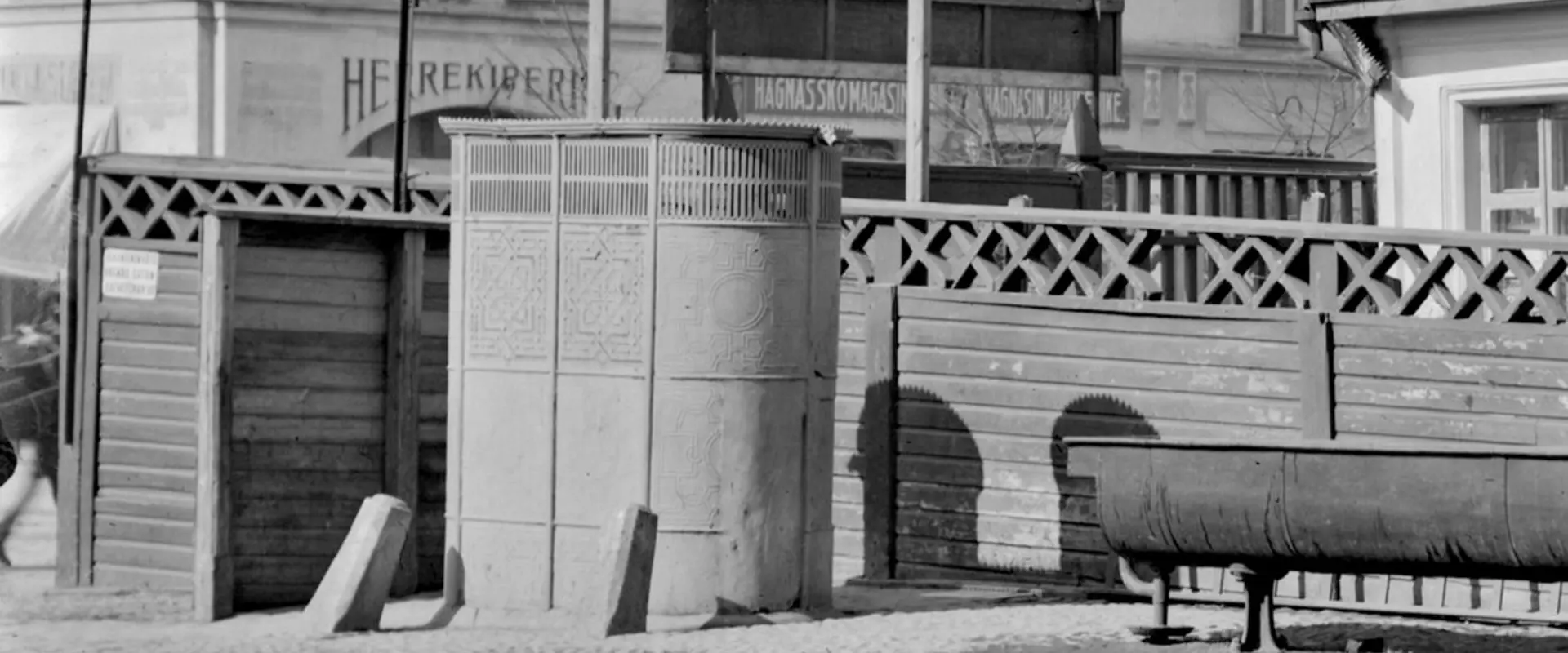
It took a couple of years for this issue to be rectified. Cast-iron urinals were installed in Esplanade Park, at the Market Square and at the eastern end of Aleksanterinkatu in late 1878. The impressive-looking facilities were built by the Scottish company Walter Macfarlane & Co. and were equipped with water pipes and gas lanterns. People’s experiences with the three new urinals were clearly positive, and the City decided to purchase more each year.
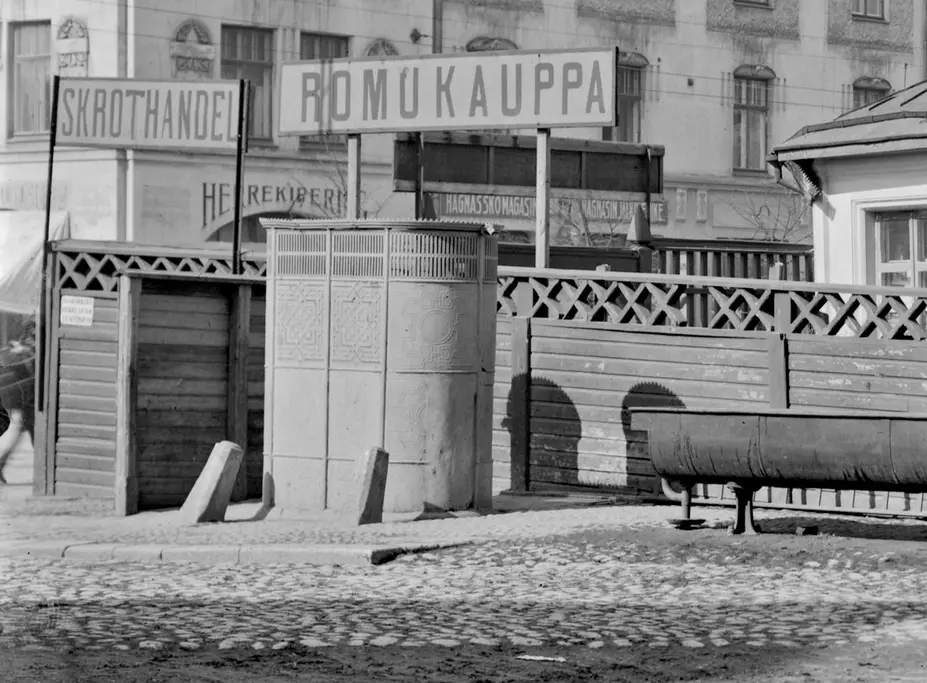
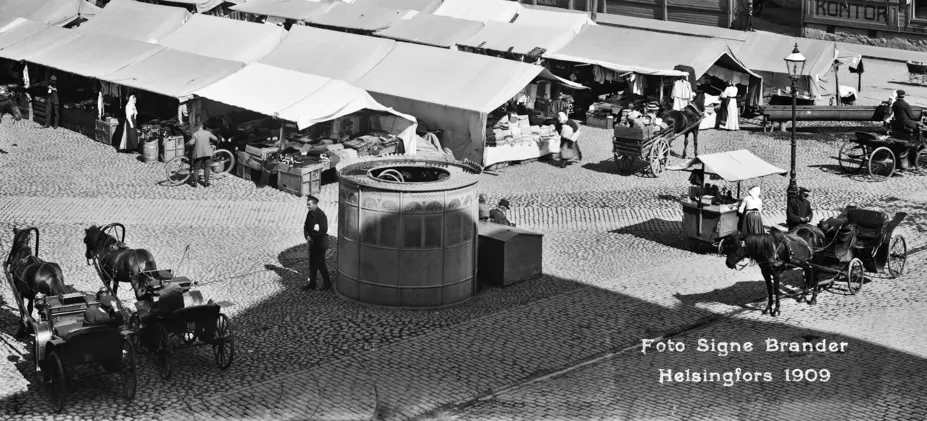
The construction of public toilets was motivated not only by homeowners’ concerns about the cleanliness of their yards, but also by public hygiene. Epidemics ranging from cholera to typhoid were the scourge of the cities, and for hygiene reasons, streets and squares needed to be kept clean of various types of organic waste. On the other hand, public toilets were – and still are – intended for the comfort of Helsinki residents and people visiting the capital city. Urinals were built in an era of people’s mobility increasing and Helsinki gaining more attractiveness. Toilets were built in key locations for trade, administration and cultural life, as mobility in the public urban space sometimes required taking care of private needs. Public toilets were part of municipal services emerging towards the end of the century. Helsinki also modernised itself in other ways the late 19th century, as new infrastructure and services were built in the city by private and public operators. A water and sewer network, gas and electricity, and tram transport were all new amenities that soon became necessities of modern life.
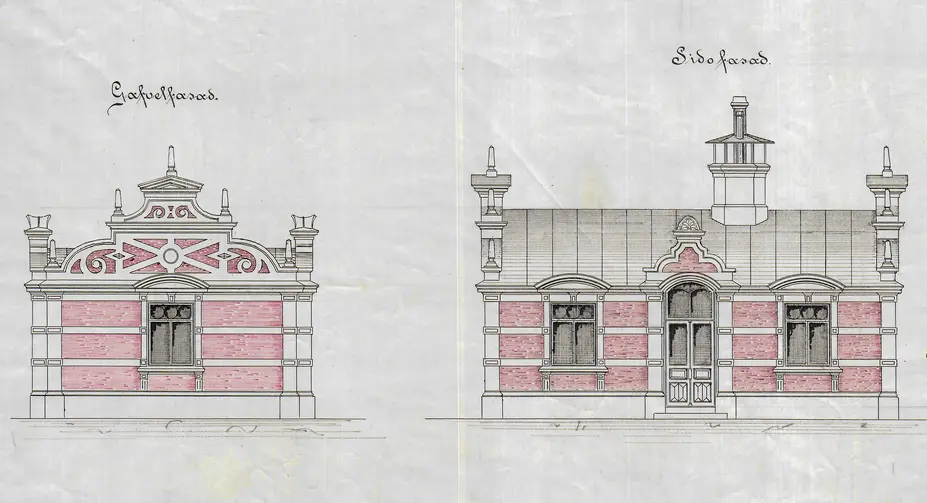
In 1889, it was reported that there were already 13 urinals and three public conveniences in the city. The latter were larger, multi-stall toilet buildings with separate sections for men and women. Two of the toilets were completed the same year: the stone toilet building in the theatre section of Esplanadi was designed by architect Theodor Höijer, while the toilet on the plot of the warehouse building in Eteläranta was designed by the City’s construction office. In addition to these, there was a public toilet with seven cubicals in the town hall operating inthe Bock House. The blueprint for the facility to be located by the gate was drawn up by architect Gustaf Nyström.
The toilets did not provide relief for everyone equally, however. The city’s numerous public urinals were for the exclusive use of the male sex. Of course, the larger conveniences described above featured separate sections for women, but even they were often smaller than the men’s facilities. Consequently, the network of toilets defined the public urban space as a men’s area.
The city in distress
In the first half of the 20th century, several plans were made to provide public toilets in Helsinki, but time and again, the plans never came to fruition or were only partially realised. Even as the city grew, the toilet situation remained stagnant.
Construction activity in the capital city was particularly high in the second half of the 1920s. The city’s population grew and new stone buildings rose in the expanding city centre. Toilets, on the other hand, were few and far between and almost non-existent in new residential areas. What few amenities the City did offer were often lacking in many ways. The cast-iron urinals built in the previous century were getting old. Their poor condition and low level of cleanliness were constantly criticised.
Helsinki was already considered to be a city of such size that new public conveniences were needed in the busy areas of the city centre. Accordingly, in 1929, the City of Helsinki Treasury decided to set up a Toilet Committee, appointing Erik von Frenckell as its chair. The committee drew up a proposal for the construction of urinals and underground conveniences in the city. In the end, the City Board abandoned its plans to build the latter facilities.
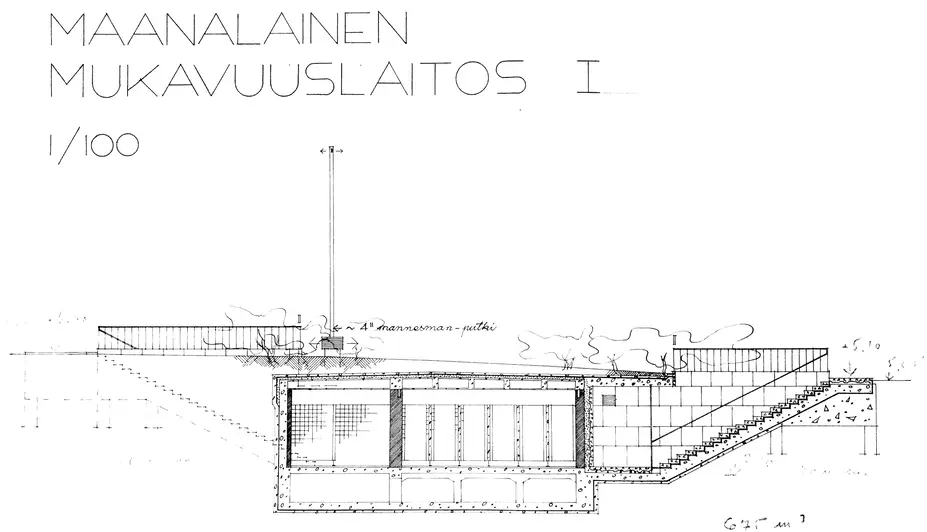
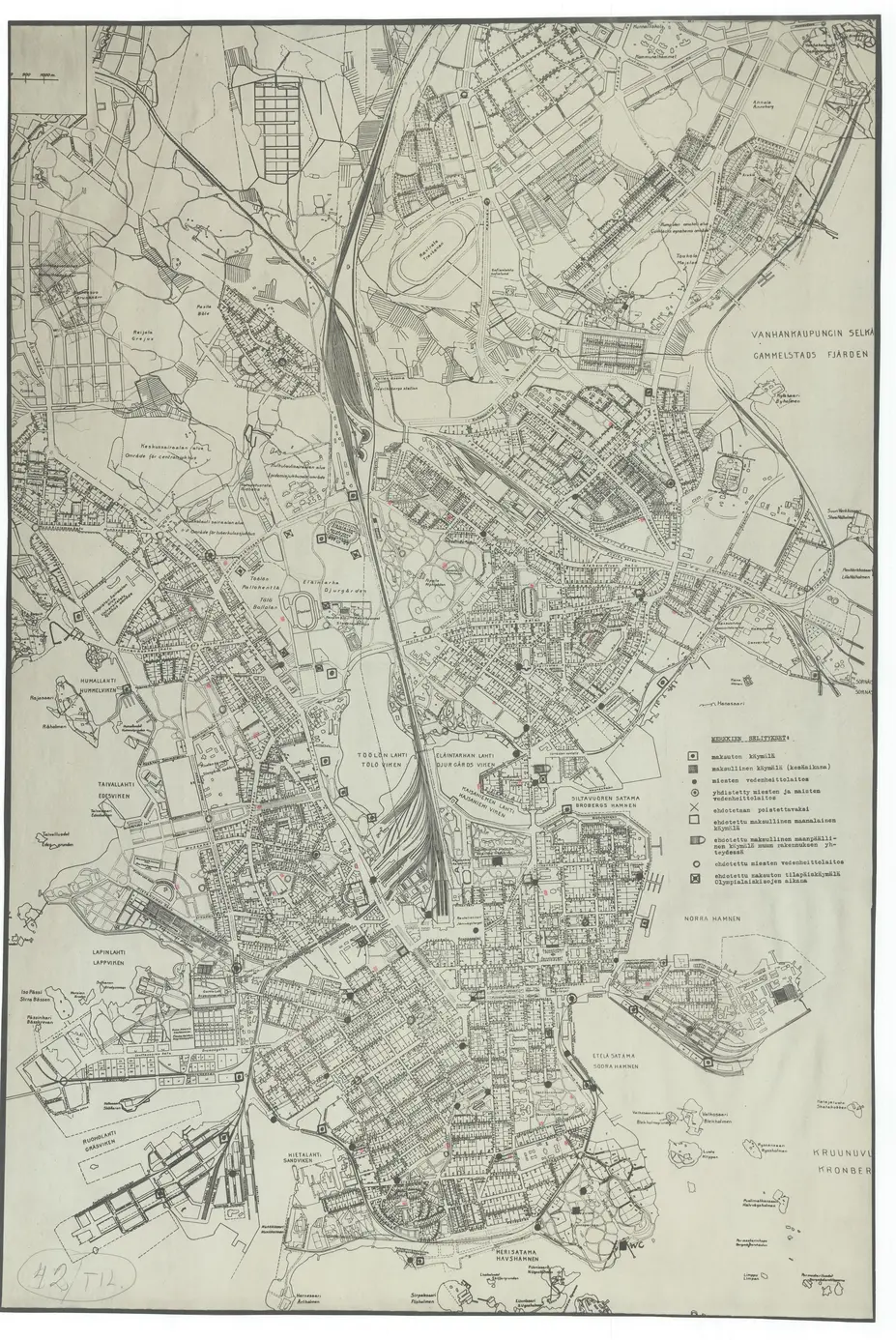
Another attempt to improve the city’s poor toilet conditions was made in the late 1930s. The plans were accelerated by the Olympic Games planned to be held in Helsinki in the summer of 1940. Another new committee was set up to deal with the matter, headed by von Frenckell. The design of the underground conveniences was entrusted to Risto-Veikko Luukkonen and Aarne Hytönen, an architect duo who had previously designed the Messuhalli building in Helsinki. Together with the head of the sanitation department, they went on a study trip to Stockholm, Copenhagen and Berlin to learn about local toilet architecture. Based on their findings, the architects drew up designs for underground toilets to be located in different parts of the city. However, the outbreak of war cancelled both the Olympic Games and the construction of new toilets.
In the middle of the war, an underground toilet was built in the bomb shelter on Erottaja in Helsinki. In addition to the toilet, the shelter featured various kiosks, a public telephone and an item storage room. The underground facilities had been designed by the City’s building department, but the aboveground pavilion was designed by Professor Alvar Aalto, who won the competition. The master architect is said to have joked that he had no other buildings to design in Helsinki than the Erottaja urinal.
Olympic fever and relief
The Olympics again provided the impetus for building new toilets in the capital city in 1951. Despite numerous previous attempts, there was not a single larger public convenience in the city apart from the Erottaja underground toilet. The toilet issue was a matter of urgency, as tens of thousands of foreign visitors were expected to arrive in Helsinki, to whom the City wanted to present an impeccable image of the country’s capital. The low number of public toilets in Helsinki had caused concern even in other countries. For example, an English travel agency manager who visited Helsinki warned his clients about a low number of quality hotels, expensive whisky and a lack of public toilets.
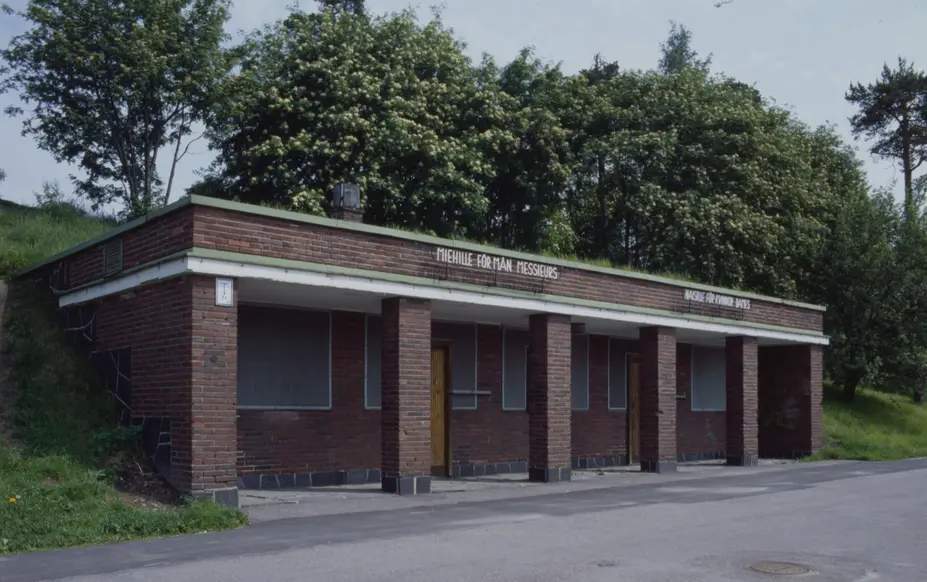
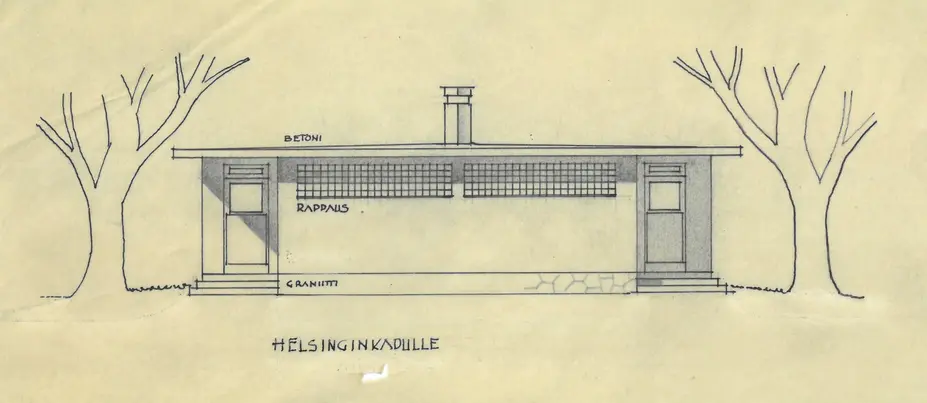
The City’s building department had already started to put together a proposal for permanent and temporary toilets, the latter to be built in the city only for the duration of the Olympics. In addition to separate toilet buildings, toilets were also to be located in market halls. In the building department, the blueprints for the new urinals and toilets were drawn up by architect Uno Moberg. These toilet buildings designed by Moberg can still be found around Helsinki: The red-brick toilets in Mäntymäki and Tehtaanpuisto have been given a new life as restaurants serving alcohol. By contrast, the white-plastered toilet in Kaivopuisto Park and the urinal structure on Seurasaarentie have been neglected.
Service station toilets and plastic urinals
In the ‘50s and ‘60s, numerous old, dilapidated urinals were dismantled in Helsinki. Instead of building new standalone facilities, it was recommended that public toilets be located in the vicinity of other services. As the motorisation of traffic increased, new service stations were built across Helsinki, and in 1956 the City Board decided that when new service stations were built on leased City land, they had to feature a public toilet. Anyone could use the toilets free of charge. Thanks to the obligation imposed on service stations, the network of toilets was extended to the peripheral areas of the city. At the same time, the City saved resources by leaving the construction and maintenance of the facilities to the oil companies. In the late 1960s, more than half of the 80 public toilets in the city were located at service stations.
Over the 1970s, the last of the cast-iron urinals from the previous century were dismantled. The previously used iron was replaced by modern plastic, at least in part. In 1972, the City tested toilets made of reinforced plastic, the first of which was installed in Varsapuistikko. However, the plastic booths did not take over the city’s parks and streets. The oil crisis multiplied the price of raw materials, and in the end, plastic urinals remained mainly a temporary solution.
French musical toilets
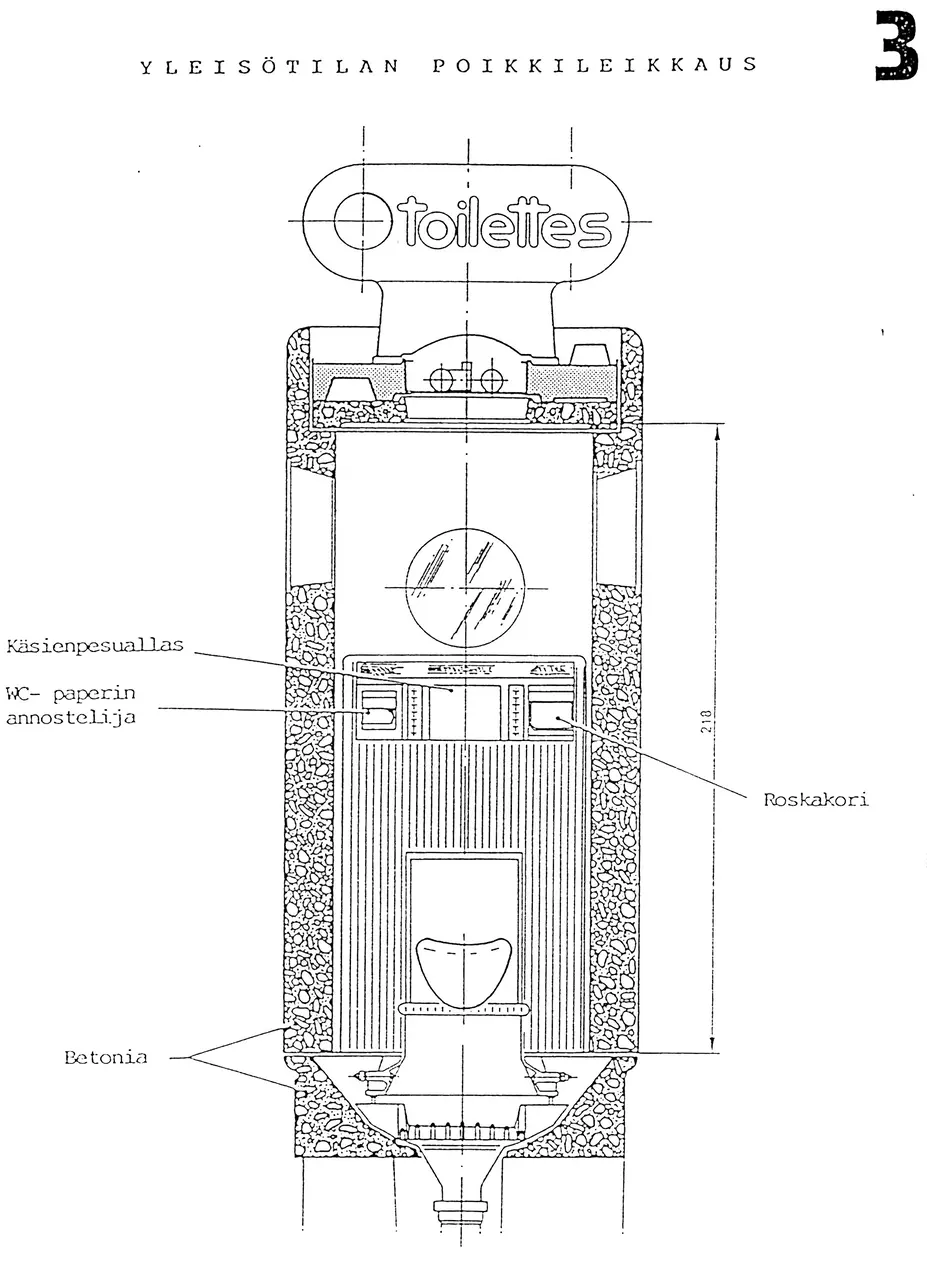
In the 1980s, the toilet conditions of Helsinki took a major step forward when the City leased automatic toilets manufactured by the French street furnishing manufacturer JCDecaux. Their space capsule-like exterior, interior heating and automated technology with sliding doors had obviously impressed the City’s lord mayor of the time, Raimo Ilaskivi. According to a newspaper report, the lord mayor had tested the toilets during an official trip to Paris, and after returning from his trip he had urged City officials to try them in Helsinki as well.
After some minor disputes regarding the cityscape, a location for the automatic toilets acquired for testing was finally allocated at the Market Hall. In June 1986, Helsingin Sanomat reported on the installation of the French toilets and described the operating principle of these modern facilities:
“Everything is fully automated. Once the visitor has washed their hands and left the toilet, the inside of the stall tilts back and the floor and the seat are automatically cleaned and disinfected. Every customer gets to visit a hyper-hygienic toilet.”
People’s experiences with the toilets were so positive that within a year, the City decided to acquire eight more. The state-of-the-art toilet technology generated not only enthusiasm, but also suspicion. Urban legends of poor souls getting stuck in urinals were circulated in the city. As a special feature, the toilets played background music while they were in use. Accordingly, they came to be called French musical toilets. Some customers were even reported to have danced so intensely to the music in the toilet that the floor structures were damaged.
Green toilets
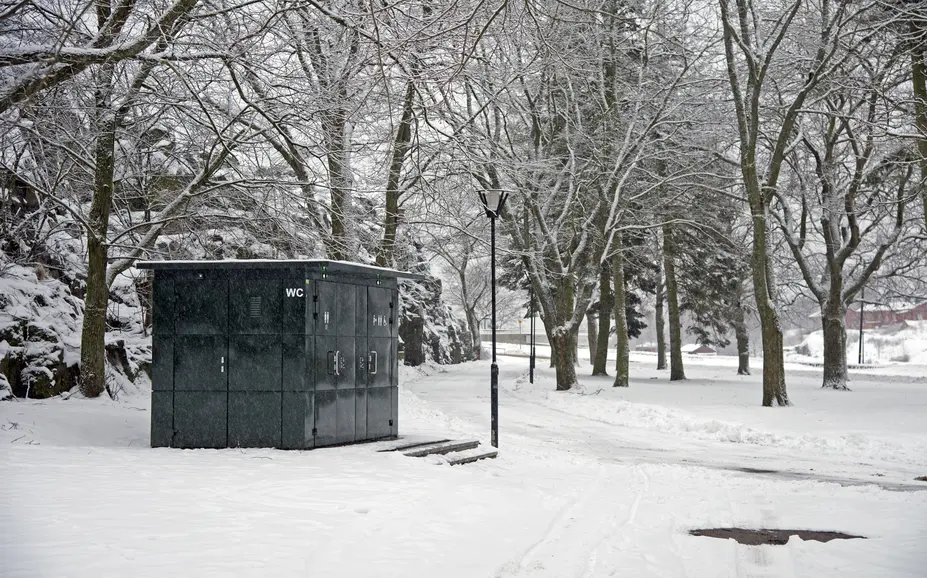
After the turn of the millennium, the French toilets were replaced with newer urban toilets. The toilets, originally Swedish-built, were adapted to the Helsinki cityscape in collaboration with the City’s architecture department. This steel-clad toilet continues to be known as the ‘green toilet’ because of its dark green colour.
The first green toilet was inaugurated with a ceremony in Esplanade Park in September 1999. At the opening ceremony of the new toilet, the chair of the City Board gave a welcoming speech and a quartet of the Polytechnic Choir entertained the audience.
The Esplanade Park toilet has since been upgraded to a newer unisex model. It is located in roughly the same spot in the park where a cast-iron urinal would give people relief back in the late 19th century.
Sources
Literature
Hornborg, Erik. 1950. Helsingin kaupungin historia II osa. Helsinki.
Lahti, Louna. 1997. Alvar Aalto ex intimo – aikalaisten silmin. Jyväskylä: Atena.
Newspapers
Helsingin Sanomat, 26 June 1986, p. 15.
Hufvudstadsbladet, 21 September 1999, p. 10.
Ilta-Sanomat, 5 April 1972, p. 9.
Uusi Suomi, 28 December 1951, p. 8.
Uusi Suomi, 25 June 1985, p. 7.
Archive sources
Helsinki City Archives (Hka)
Berättelse angående Helsingfors stads kommunalförvaltning 1889. Hka.
Magistratens och Drätselkammarens skrifvelser angående utgifts- och inkomstförslaget för år 1880. Printed documents of the Helsinki City Council 1879. Hka.
Handlingar angående revision af Helsingfors stads räkenskaper för år 1880. Printed documents of the Helsinki City Council 1881. Hka.
Minutes of the City Council with appendices 17 October 1876, Section 17. Hka.
Minutes of the City Council with appendices 22 October 1931, Section 1,524. Hka.
Minutes of the City Council with appendices 25 January 1939, Section 21. Hka.
Minutes of the City Council with appendices 22 October 1951, Section 2,567. Hka.
Minutes of the City Council with appendices 19 April 1956, Section 1,230. Hka.
Minutes of the City Council with appendices 2 September 1965, Section 2,291. Hka.
Minutes of the City Council with appendices 3 February 1969, Section 367. Hka.

