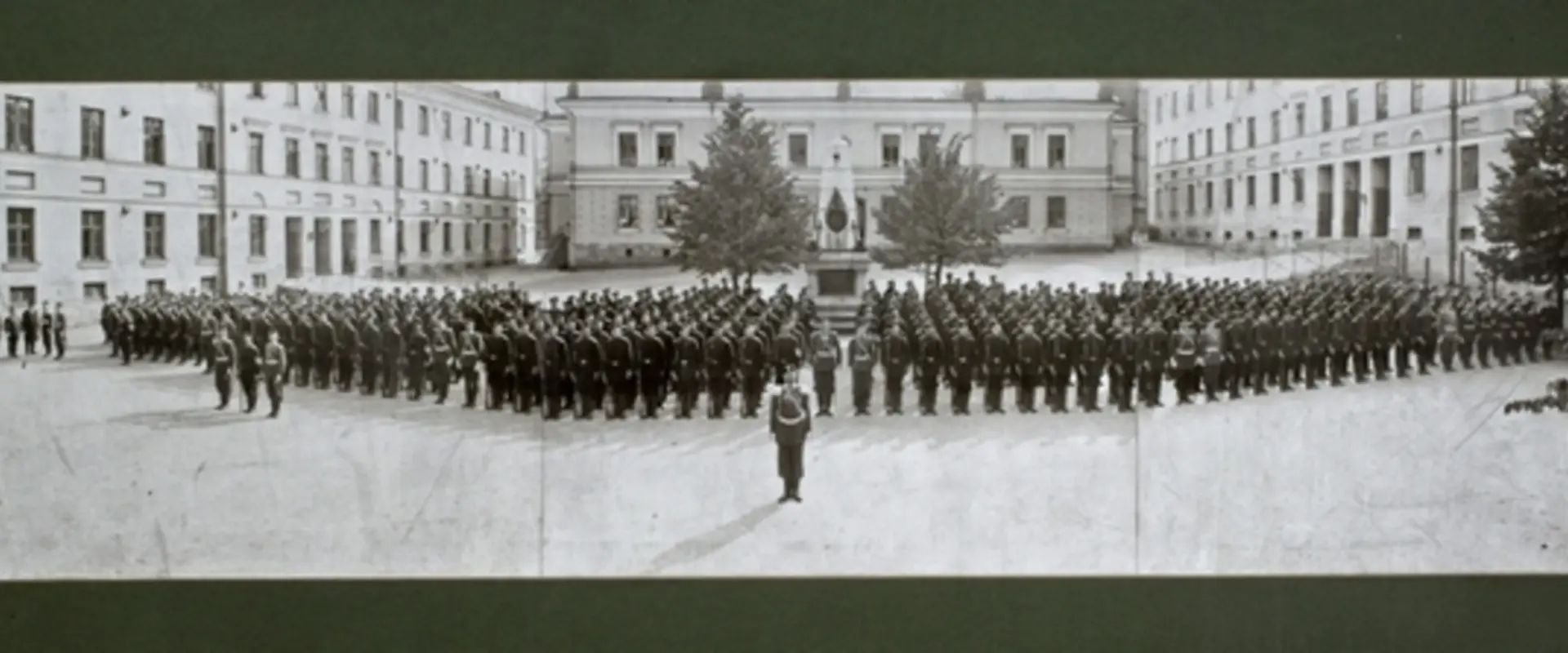
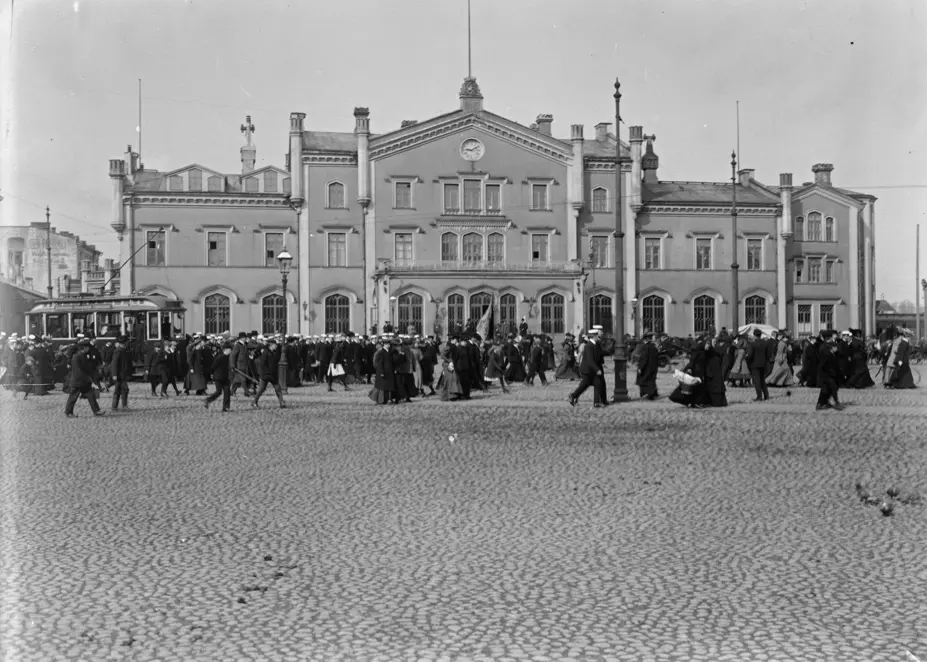
On 6 September 1877 there was a festive atmosphere in Helsinki railway station. The Finnish Guard or officially the Lifeguard’s Third Finnish Sharpshooter Battalion was leaving. The Guard, established in 1812, had previously taken part in some campaigns abroad but until now the Finns had not joined in any real battles during a full-scale war. All people who managed to squeeze themselves into the crowd tried to catch at least a glimpse of the soldiers, who proudly showed off their new dark blue uniforms.
The tsar calls
The Russian tsar Alexander II used to review the Finnish Guard every summer when the battalion trained at Krasnoye Selo near Saint Petersburg. In spring 1877 the battalion consisted of around 600 men. For the campaign at least the double amount was required, so in the summer enrollers were sent throughout Finland to enlist young men.
Many Finnish men were willing to join in the war adventure, because they had read horrifying descriptions in newspapers about the situation of their Christian brothers in the Balkans. International correspondents reported that Christians suffered heavily under the oppression of the Muslim Ottoman state.
-
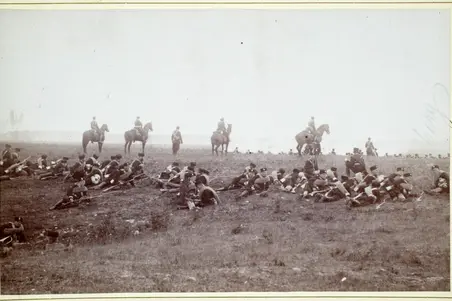
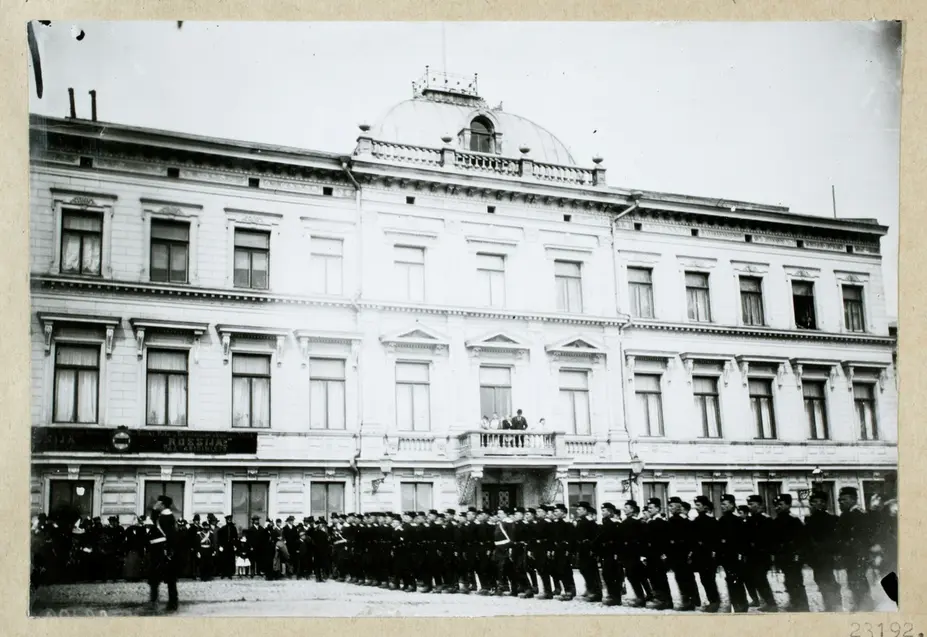
The Finnish Guard during exercises in Lappeenranta in 1891. Tsar Alexander III was present. Photo: The Finnish Heritage Agency / K. E. Ståhlberg -
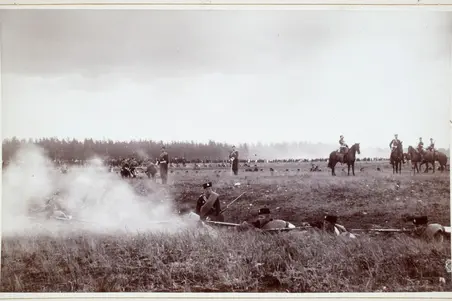
The Finnish Guard during exercises in Lappeenranta in 1891. Tsar Alexander III was present. Photo: The Finnish Heritage Agency / K. E. Ståhlberg


The Eastern Question
The interests of the Great Powers during the 1800s concentrated increasingly on dividing the enormous Ottoman Empire (1299–1922). Especially England, France, Russia and Austria-Hungary tried to grab the Ottoman European provinces in the Balkans and parts of Asia and Africa. In the newspapers and propaganda this process was called the Eastern Question.
In April 1877 Russia declared war against the Ottoman Empire and sent troops via Romania to Bulgaria. Romania declared independence in May but on the southern side of the Danube River, Bulgaria remained Ottoman territory. Only in 1908 Bulgaria declared its independence.
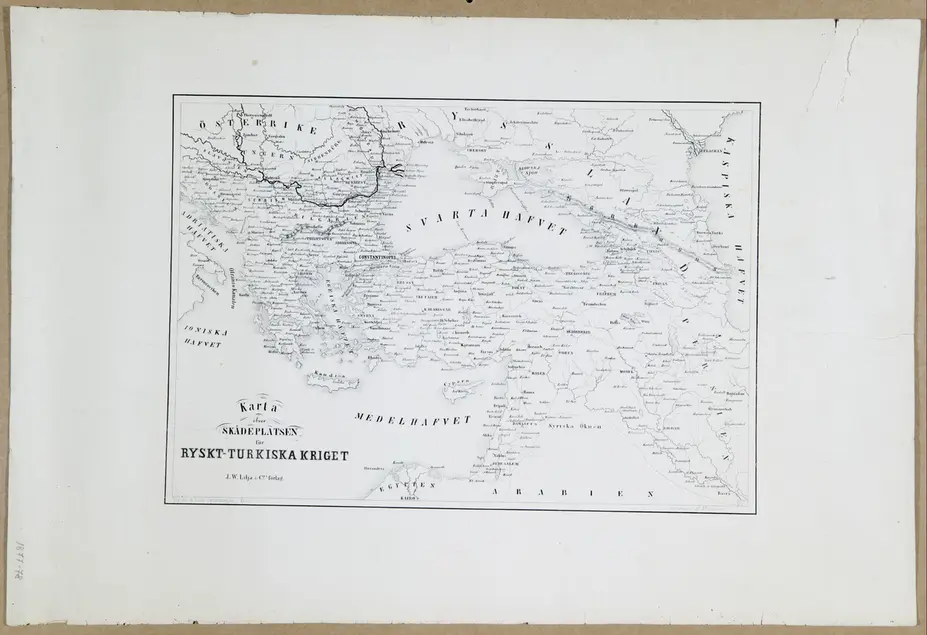
This was not the first time Russia and the Ottoman Empire were at war. The two countries had waged at least a dozen wars during the past few centuries. The war was expected to last only for a few months but in August 1877 it became apparent that more units must be sent to the Balkans. The Finnish Guard was one of the many auxiliaries enlisted to save the honour of Russia. Also Romania, Serbia, Montenegro and thousands of Bulgarians were involved in the war on the Russian side.
The train departs
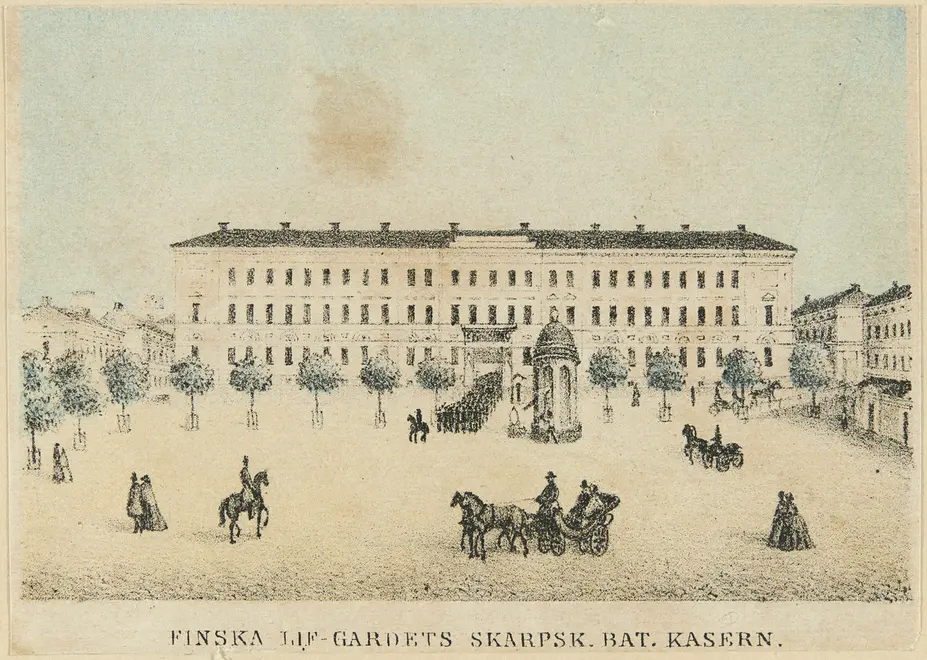
The Finnish Guard held church service at 5:45 AM on Kasarmitori and then marched to the railway station while the music played. The Guard had their own music corps with some fifty musicians. Together with soldiers, officers and commander George Ramsay travelled several civilians, among them the priest Gustaf Rancken, medical doctors G. G. Winter and C. F. E. Wahlberg, and the military judge Oskar Ståhlberg.
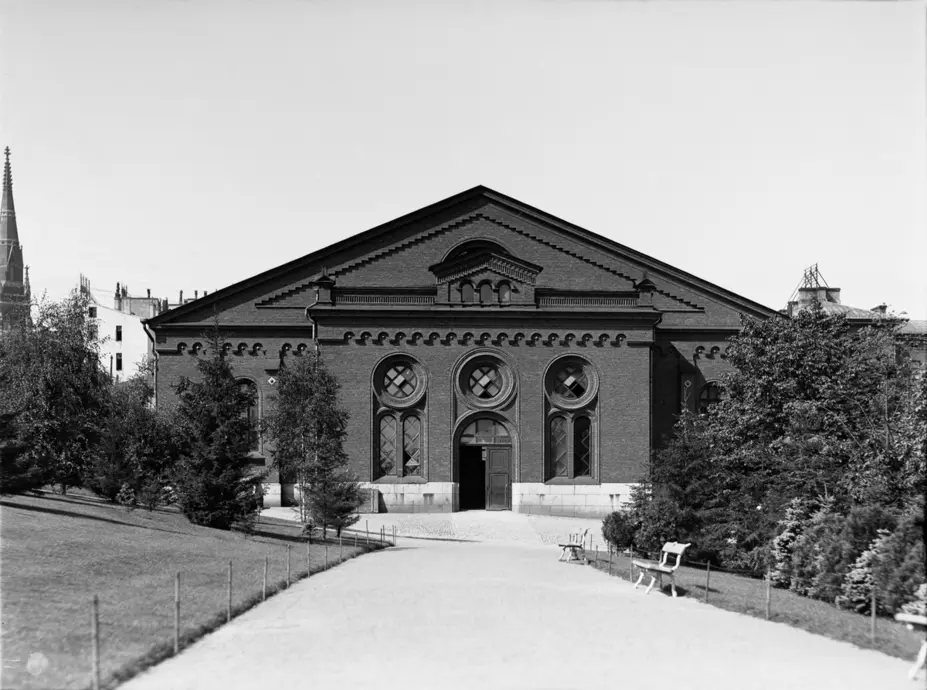
Soon it was time to say goodbye, as the train left at 7:20 AM. The travellers had been celebrated for many days in Helsinki. The battalion was inspected by a Russian general on Senaatintori and the soldiers paraded in their field uniforms at Kamppi. Several clubs invited the officers to dinners, and the city’s inhabitants arranged a farewell feast for the soldiers in the arena, and a festive dinner for the officers at Kaivohuone restaurant.
While the train slowly chugged eastwards, festivities continued. In Viipuri the train stopped for a few hours and the inhabitants invited the travellers to a feast. In the capital Saint Petersburg more homages took place before the Finnish Guard continued its southward journey.
Towards a new world
The Finnish Guard had orders as fast as possible to reach the vicinity of the town Pleven (Plevna or Plewna in older sources) in northwestern Bulgaria. The journey lasted about a month by train through present-day Russia and Ukraine to Romania. Many other military units were also on their way to the front which made the journey extremely slow. The last stage to the Danube River was covered by foot.
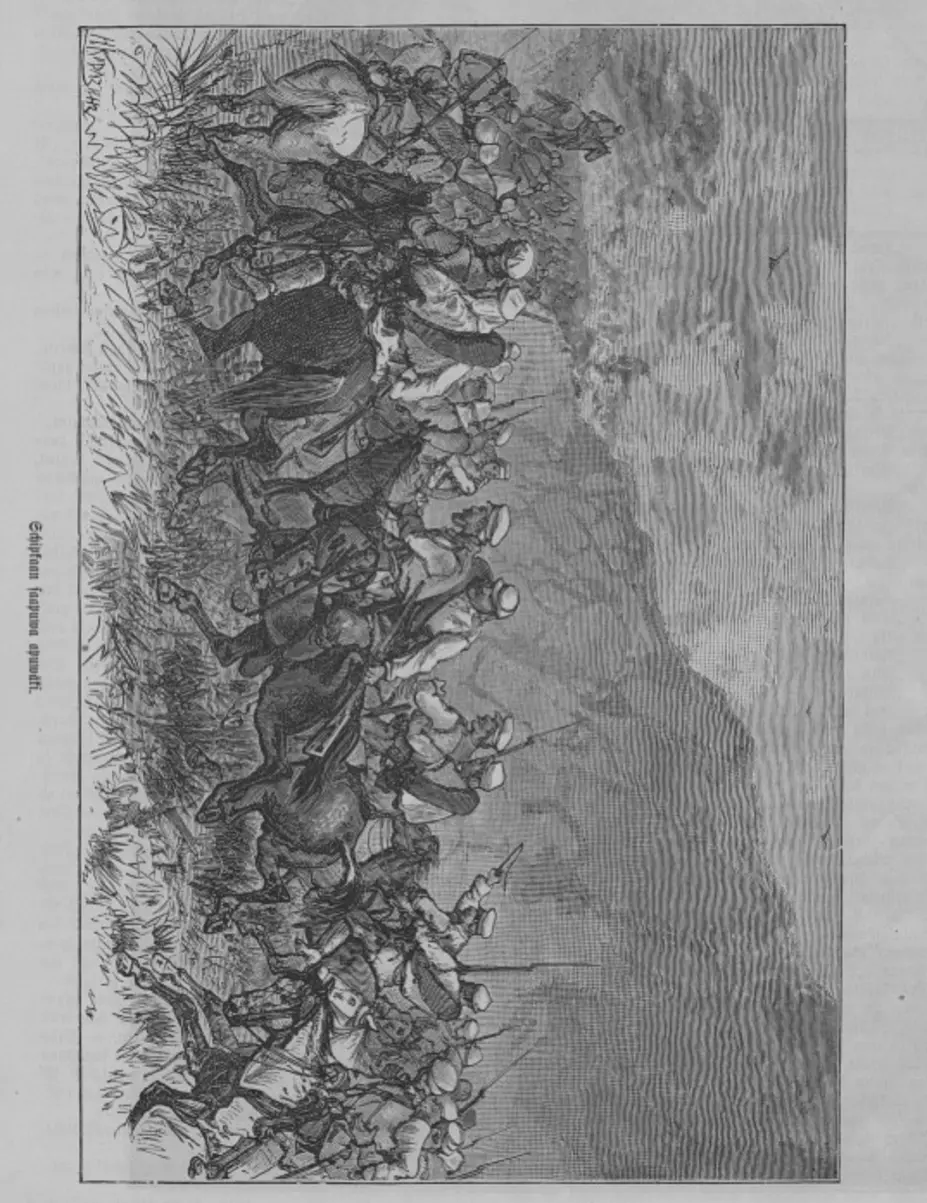
On 3 October 1877 the Guard marched over the pontoon bridge built by the Russians over the Danube to the town Svishtov (Sistovo or Sistova in older sources) in the Ottoman Empire. Tsar Alexander II inspected his army and directly sent the troops onward to Pleven which was besieged by the Russians since several months.
From an international legal point of view, the Finnish Guard belonged to an invading army which occupied areas in a foreign state. But the Finns had more important issues to solve than world politics. The autumn rains had begun, and the roads turned into muddy mush when tens of thousands of men, horses, oxen and carriages tried to reach Pleven. The distance was only a hundred kilometres, but it felt like a thousand.
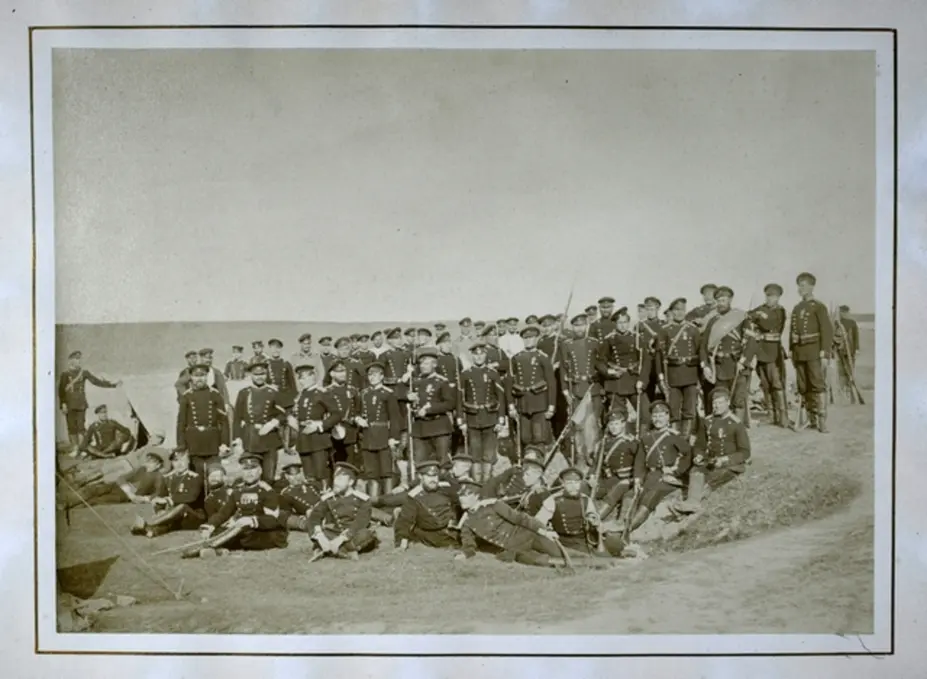
When the Guard arrived in Barkach village just south of the town Pleven, food became scarce. The carriages with food and equipment were stuck in the mud. There were too many mouths to feed in the area, because the Russian commanders had gathered the bulk of the army around the town. The Finns noted with great disappointment that the promises given by the Russian army of a daily portion rye bread and herring – and an occasional strong drink – were as empty as the soldiers’ stomachs.
The soldiers tried to survive by gathering maize and grapes in the fields and getting food from villages. The officers did not feel much lack. Those who had money could buy anything from champagne and white bread to caviar and chocolate from camp merchants who followed the army. The officers often received parcels with foodstuff and clothes from their families in Finland, too.
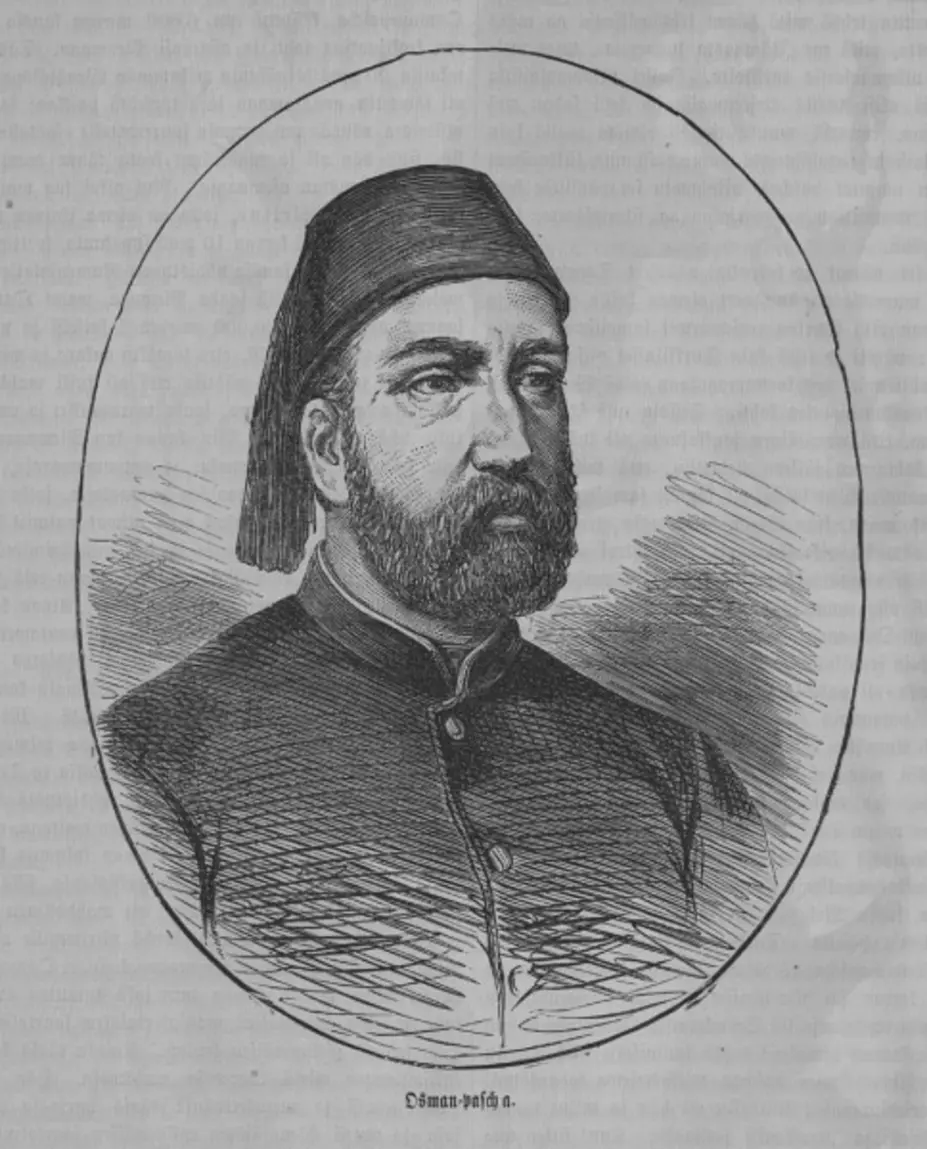
Active women
Telegrams from the frontier could be sent only in urgent situations, because telegraph lines must remain open for important messages. Commander George Ramsay (1834–1918) managed despite the restriction to send telegrams to his family, in addition to writing almost daily letters to his wife Lilly (Elisabeth née Cumming, 1842–1919). The Ramsay family lived, like other officer families, during winter in the barracks and in summer on their estate outside Helsinki.
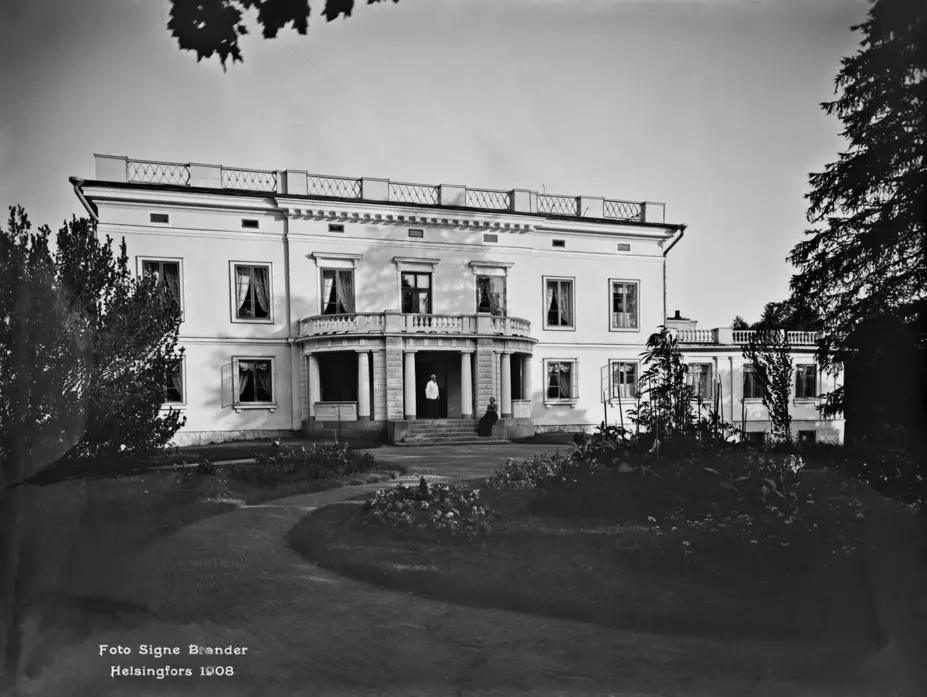
At home in Helsinki, the officers’ wives waited impatiently for news from the Balkans and read diligently both Finnish and international newspapers. They visited each other daily to exchange information about the war and spread any news further to the soldiers’ families in the barracks. Lilly Ramsay, who grew up in Saint Petersburg in an English-Scottish family, followed English, French and Russian newspapers in addition to Swedish-language newspapers and magazines.
Women’s aid committee
In October 1877 the officers’ wives led by Lilly organised an aid committee for the soldiers at the front and their families in Finland. Soldiers’ wives started to sew clothes and knit socks and mittens. A few months later the committee was able to give clothes and toys as Christmas gifts to soldiers’ children, and at the beginning of 1878 they sent 1,200 shirts and other clothes items to the soldiers in the Balkans.
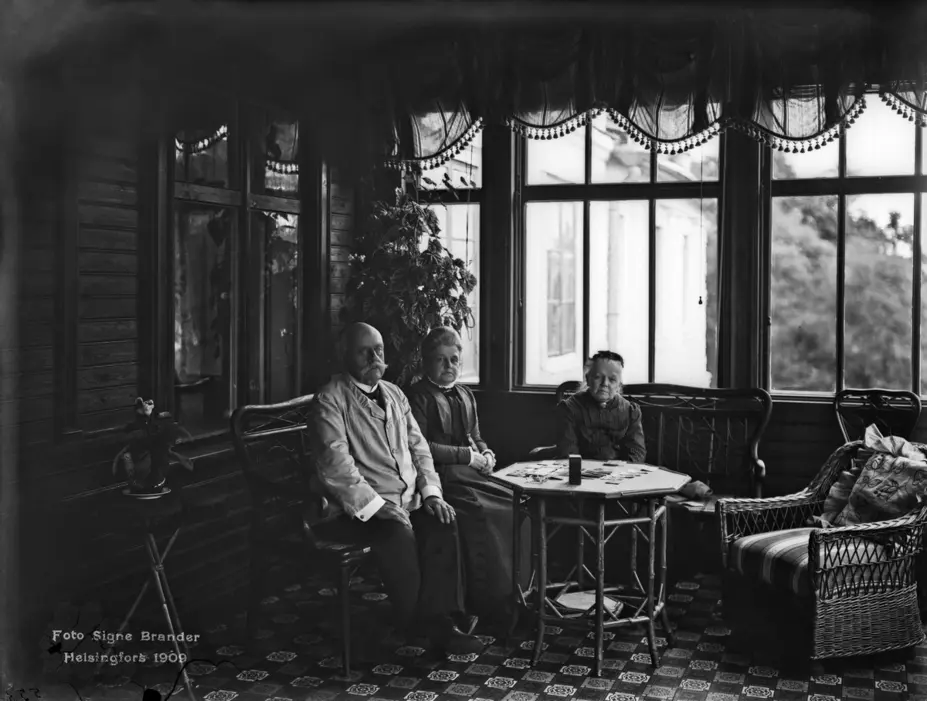
Soon the women’s cause became the cause of a whole nation. Thousands of people in Finland contributed to the work of the committee. In contrast to parcels addressed to officers, which arrived fairly rapidly to the front, the winter clothes for soldiers arrived only in spring. Then it was too warm for woollen clothes, and the soldiers were already swimming in the sea outside Constantinople (Istanbul). The delay was not the fault of the women – Russian army logistics were not particularly efficient.
Battle at Gorni Dubnik
In the evening on 23 October 1877 the Finnish Guard received orders to prepare for battle. The soldiers were allowed to carry only a bread bag and the most necessary things. Their heavy rucksacks were left to be transported by carriages, and the soldiers saw them next only several months later in Istanbul.
During the night the Finnish Guard marched to Gorni Dubnik village (in older sources Gorniy or Gorny Dubniak). The aim was to cut off the Ottoman army supplies of foods, medicines and military equipment to the town of Pleven. In the morning on 24 October a church service was held.
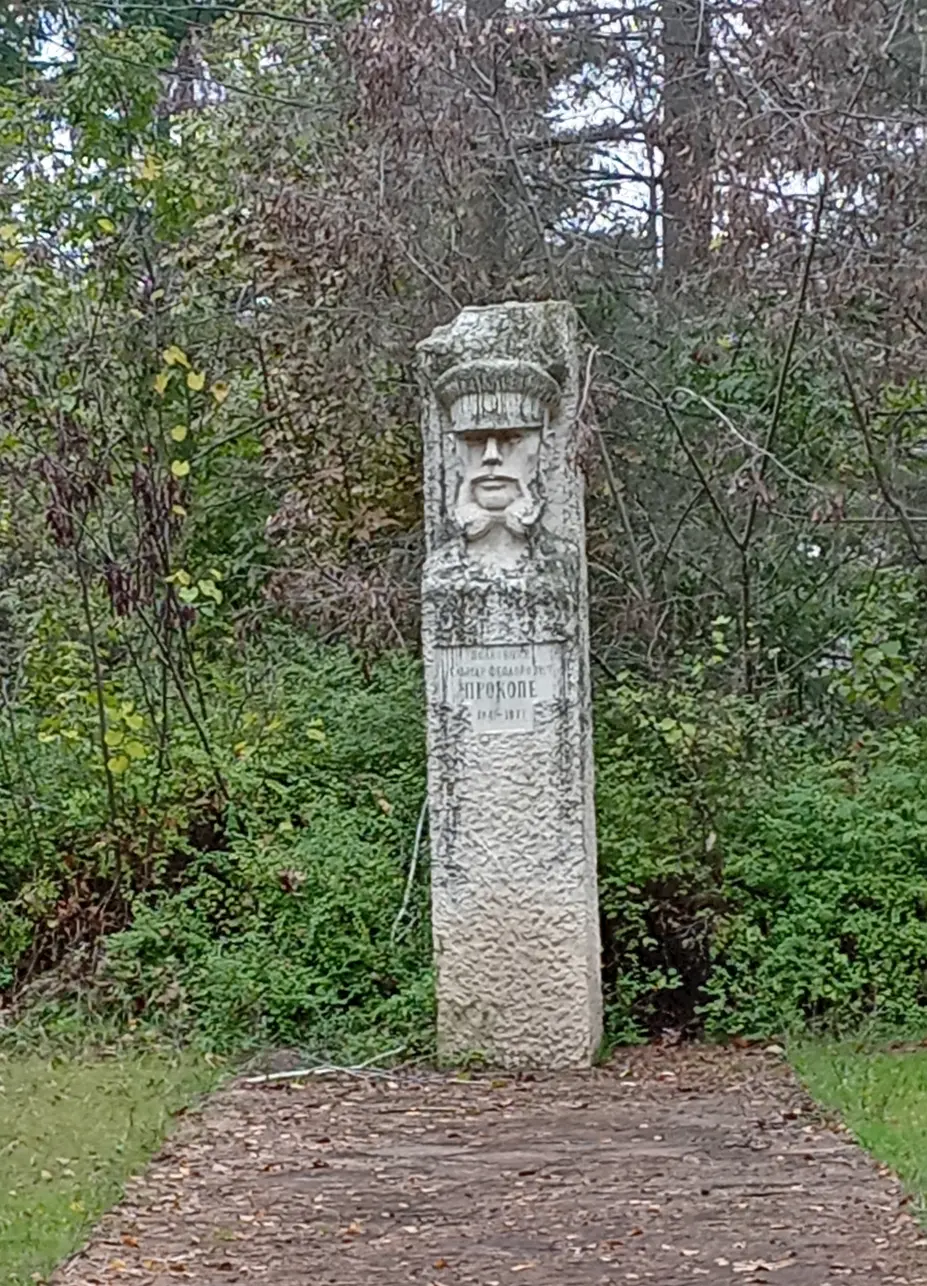
The battle lasted all day. Only at sunset the Ottoman troops surrendered. Newspapers wrote that the Finnish Guard fought all day in the front line, but in fact the Guard was kept in the background. The seasoned Lifeguard’s Finland Regiment which consisted of Russian soldiers mainly from the area around Saint Petersburg, battled in the front line. Hjalmar Procopé (1842–1877) from Finland was one of the commanders of this regiment.
The Russian commanders were well aware that the Finnish Guard had no war experience, so it would have been too risky to send them into the front of the battle. The Guard lost comparatively few soldiers and officers. The 22 men killed in battle and a musician, who died on the same day of illness, were buried on the battlefield.
The road to Istanbul
After the battle at Gorni Dubnik the Finnish Guard participated in some skirmishes and minor fights. The next serious trial was the crossing of the Balkan Mountains after Christmas 1877. Snow lay deep, winter storms raged and temperatures were freezing. The organisation was once more chaotic and the march very slow. At the beginning of January, the Guard arrived in Sofia, now capital of Bulgaria, where they found both food and accommodation.
From Sofia the Finnish Guard marched toward Istanbul. On the way the Finns encountered for the first time the horrible consequences of war. Thousands of refugees tried to flee the advancing Russian army, but many froze to death or were murdered. The Finns called the march through southern Bulgaria “Death Road”. They did not perceive anyone as enemy anymore: all were only humans.
When the Finnish Guard arrived in Istanbul a new danger awaited them: typhoid fever. The epidemic took the lives of a few hundred Finns, and several hundred fell ill but survived. In April 1878 the Finnish Guard was sent home. Upon arrival in Helsinki all uniforms and clothes were burnt, as spotted fever (epidemic typhus), the most dangerous kind of typhoid fever, is spread by lice.
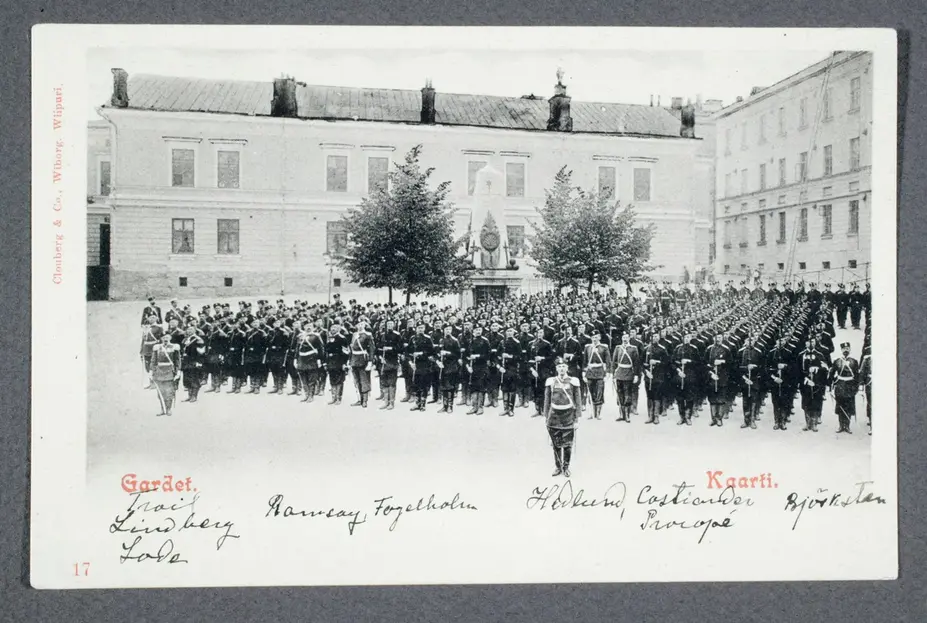
Memorial in Helsinki
The battle at Gorni Dubnik was important for the Finnish Guard and the emerging nationalism in Finland. It was the first “real” battle for the Guard and those who had participated were seen as heroes. Several of them published books or wrote articles about their experiences.
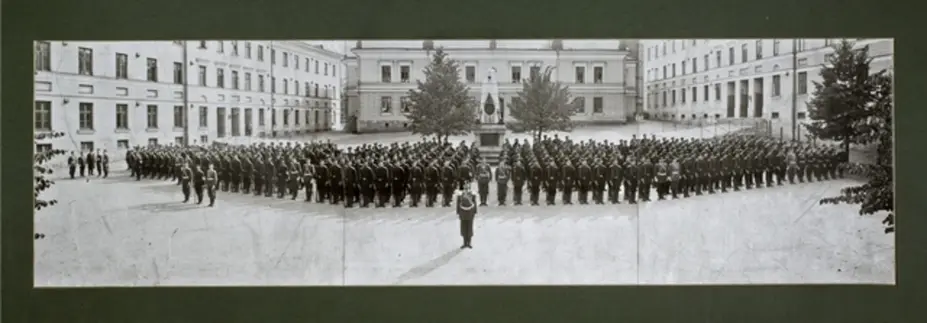
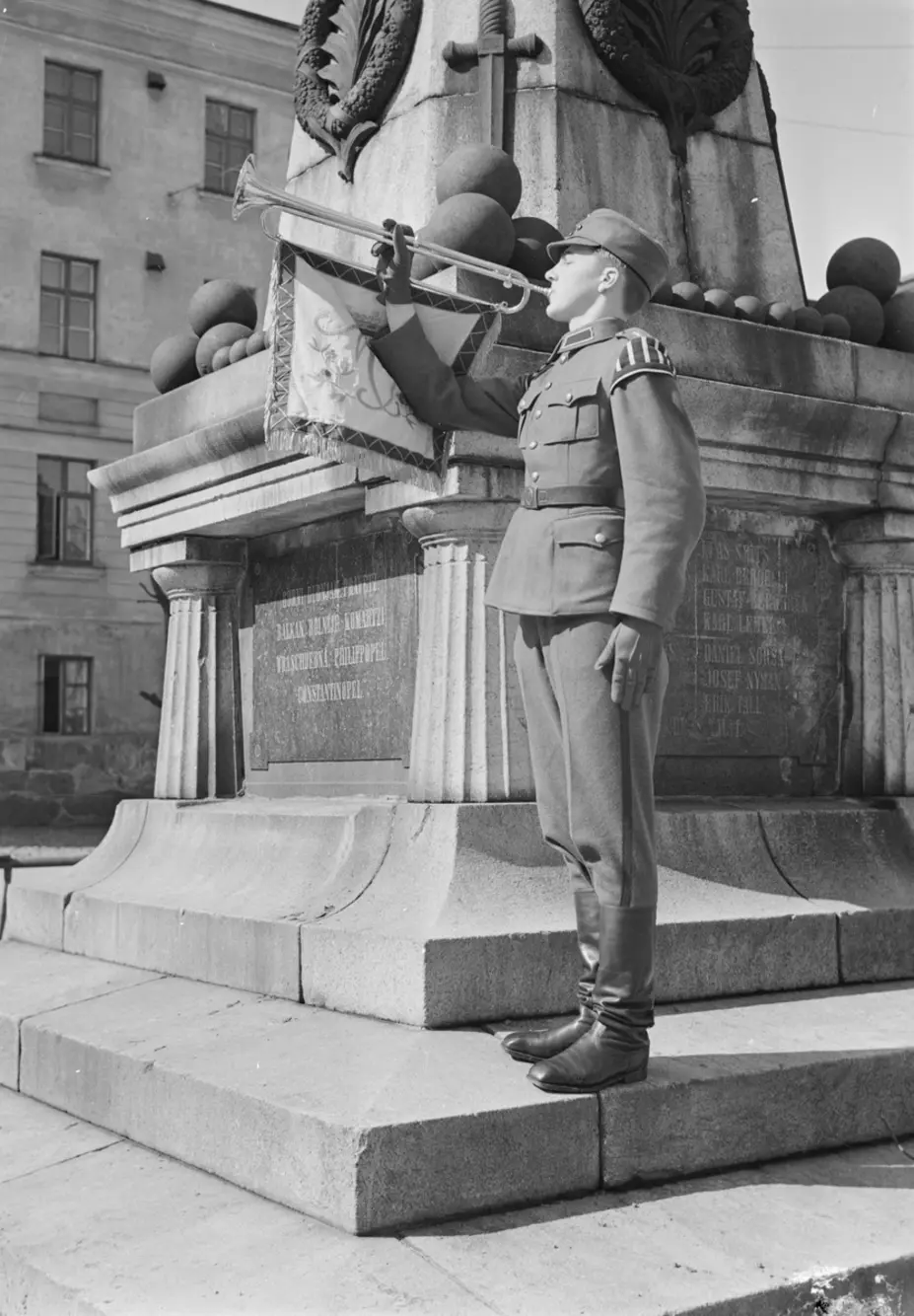
On the anniversary of the battle on 24 October 1881 a monument was inaugurated in the courtyard of the Guard’s barracks in Helsinki. The architect F. A. Sjöström designed and Stigell’s stonemasonry company cut the memorial with names of fallen soldiers and officers.
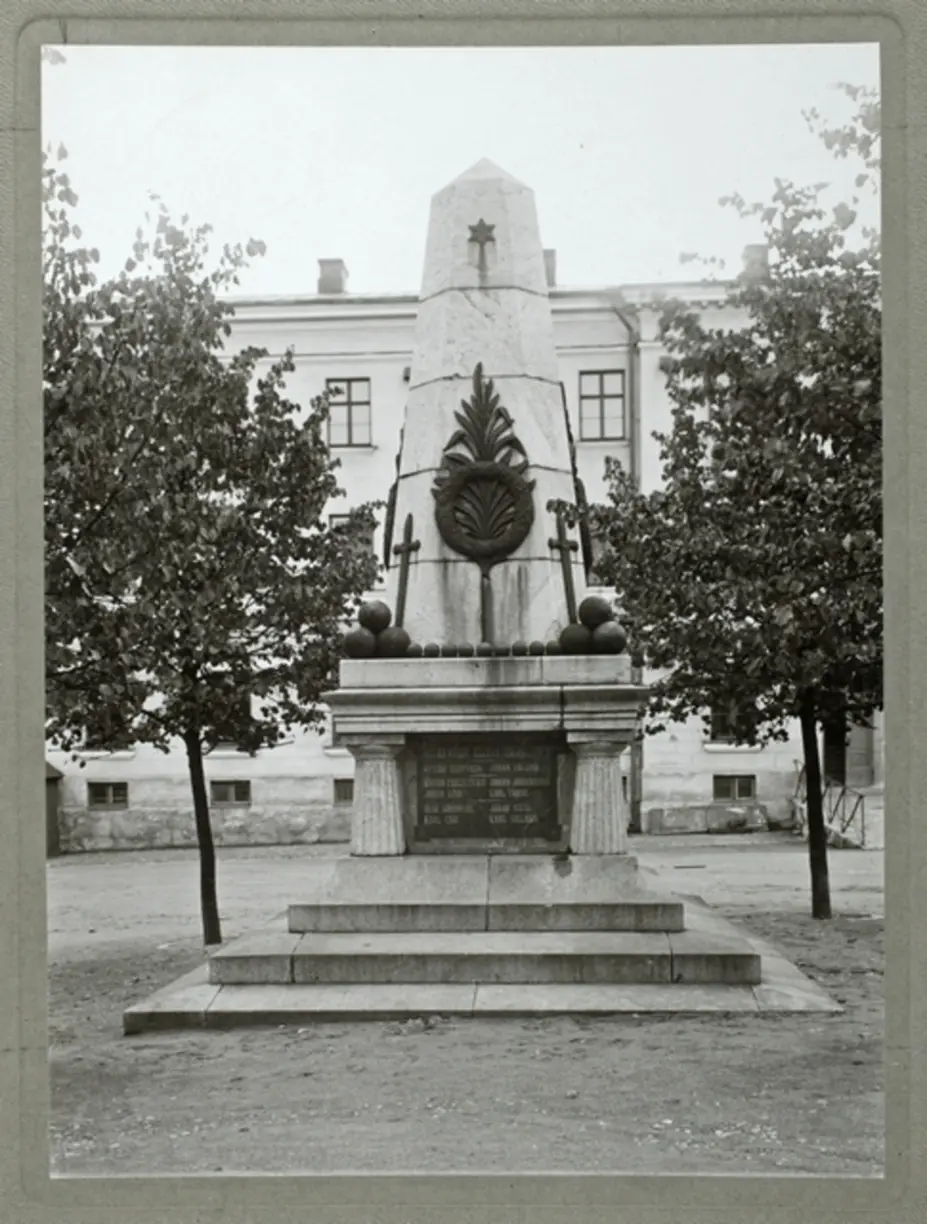
The monument still stands in the courtyard of the former barracks, but it is no longer accessible for visits except by special permission. Ceremonies take place annually on 24 October and 3 March. On the anniversaries for the battle at Gorni Dubnik in 1877 and the armistice treaty in 1878, mainly the Bulgarian Embassy and friends of Bulgaria in Finland lay wreaths at the memorial.
Memorial in Gorni Dubnik
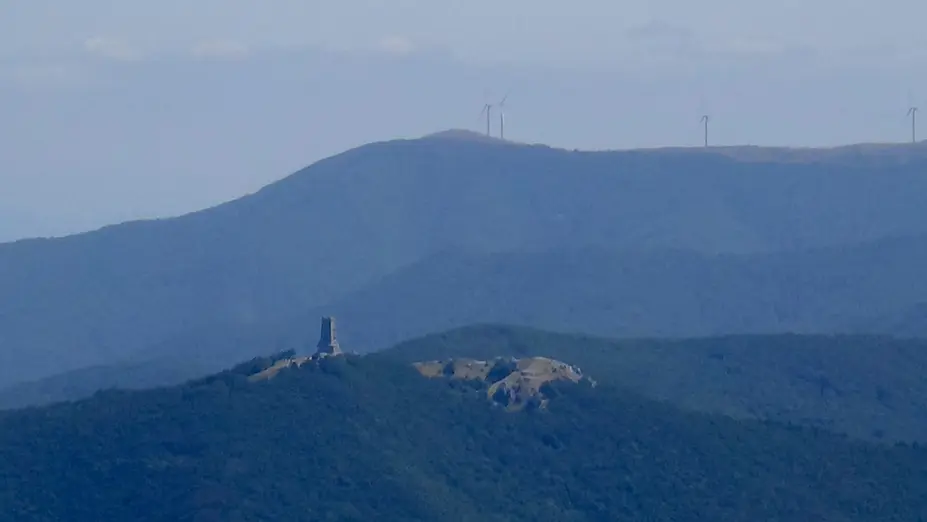
After the memorial in Helsinki was inaugurated, a few Guard officers travelled to Bulgaria. The Russian war ministry had already in 1879 erected thirteen monuments in the battlefield outside Gorni Dubnik, but a monument for the Finnish Guard was still missing. At the end of 1881 the memorial was inaugurated with the Russian text: To the fallen comrades. Lifeguard’s Third Finnish Sharpshooter Battalion.
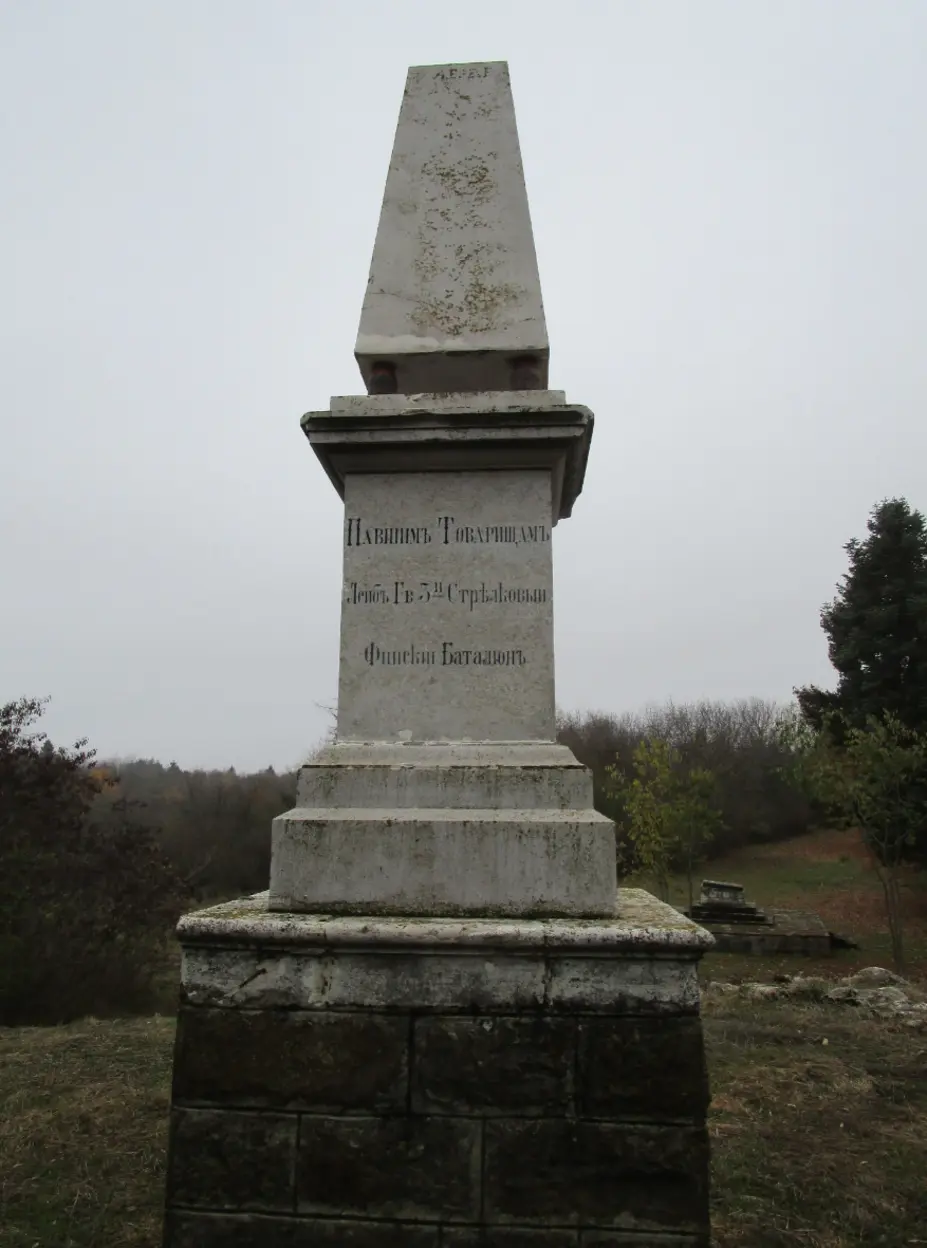
The memorial stands now in Park Lavrov. The park was built in the 1950s by villagers, and the village cares for the dozens of monuments in the park. Since 2013 there are also translations in Bulgarian, Swedish and Finnish of the Russian text, and the names of the 23 persons buried there, the result of fruitful cooperation between Finnish visitors and Gorni Dubnik village. On 24 October every year memorial ceremonies are arranged in Park Lavrov, where also the Embassy of Finland usually participates.
Historical significance
Attitudes in Finland changed radically between 1877 and the beginning of the 1900s. When the Finnish Guard journeyed to the Balkans, Alexander II was “our tsar” and Russia’s war “our cause”. This can partly be attributed to extensive Russian propaganda in Finland. Many Finns worked during the war to create and translate songs, articles and propaganda texts for newspapers and magazines. Some of the songs are still known today.
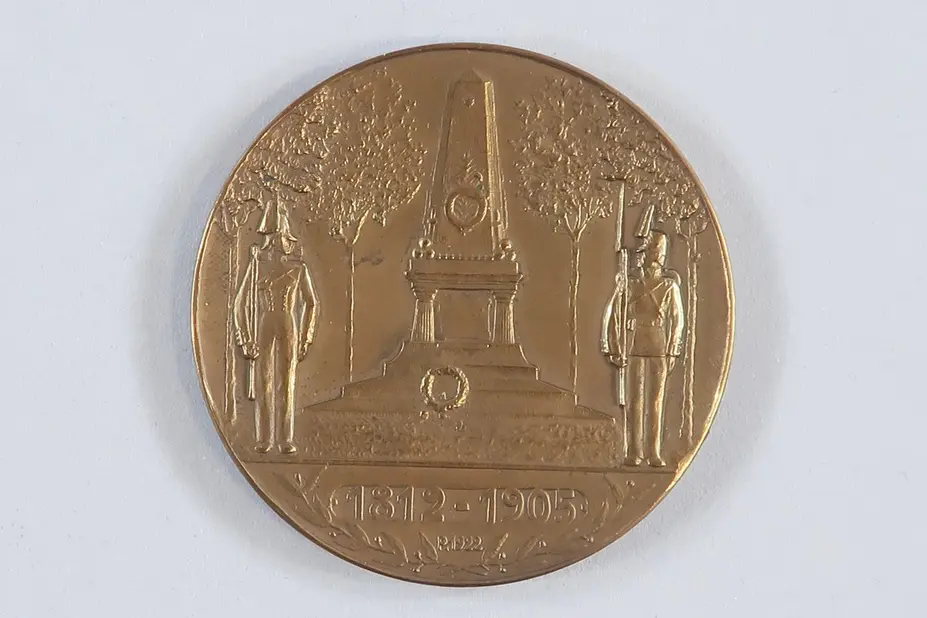
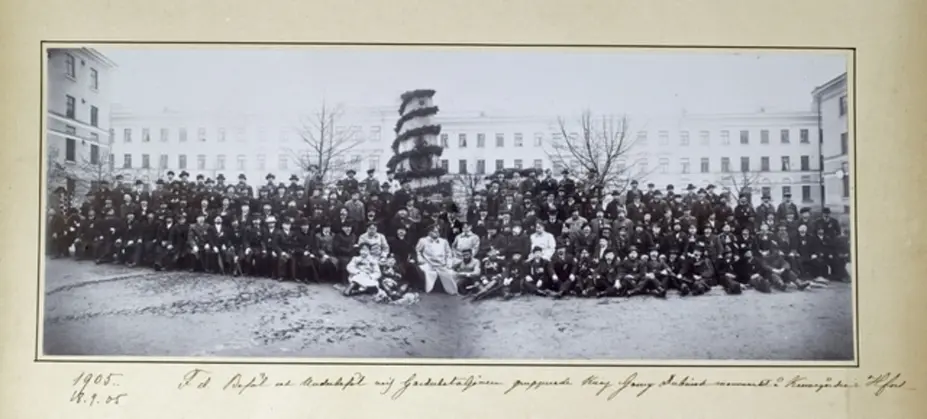
During the Russification period around 1900, the battle at Gorni Dubnik and the campaign in the Balkans were counted among the most important events in the history of the Finnish Guard and Finland. A conscription army was established in 1879 with George Ramsay as commander, but in 1901 tsar Nikolay II ordered the Finns to serve in Russian units. The Finnish Guard was disbanded in 1905, yet the veterans continued to gather around the monument for many decades afterwards.
The contacts between Gorni Dubnik village and Finland are special. For decades Finns, including a few presidents of Finland, have travelled to the memorial in Bulgaria. Official Bulgarian representatives and villagers from Gorni Dubnik have visited the monument in Helsinki. During World War II, when the villagers heard about the difficult situation in Finland, school pupils in Gorni Dubnik and nearby villages collected foodstuffs and other necessities. Wheat flour, beans, soap, tobacco, spirits and other goods were sent in 1942 by train via Germany to Finland.
Literature
Alfthan, A. von 1879. Från Jassy till Konstantinopel. Anteckningar från turkiska fälttåget 1877–78. Helsingfors: G.W. Edlund.
Backström, Å. 1996. Från mobilisering till demobilisering. Finska Gardets befäl 1877–1878. Genos 67.
Backström, Å. 1991a. Suomen Kaarti Balkanin sotaretkellä, 1877–1878. Genos 62.
Gripenberg, G. A. 1905. Lifgardets 3 finska skarpskyttebataljon 1812–1905. Ett minnesblad. Helsingfors: Söderström & Co.
Jernvall, J. 1899 (1881). Wääpeli Lemminkäisen päiväkirja. Suomen kaartin retkestä Konstantinopolin muurien edustalle. Wuosina 1877–1878. Helsingfors: G.W. Edlund.
Ståhlberg, Sabira (toim.) 2018. Från Munksnäs till Konstantinopel. Familjen Ramsays brev under kriget på Balkan 1877–1878. Varna: Lecti Book Studio.
Ståhlberg, Sabira 2015. Finska Gardet på Balkan / Suomen Kaarti Balkanilla / Finnish Guard in the Balkans. Varna: Lecti Book Studio.
Wahlberg, C.F. 1878. Från en härfärd i Turkiet. Vid Lifgardets 3:dje Finska Skarpskyttebataljon och Ryska Gardeskåren. Anteckningar från rysk-turkiska kriget 1877–1878. Helsingfors: Hufvudstadsbladets tryckeri.
Wallin, Sten Anders 2005. Tuntematon sotilas Turkin sodassa. Pirkko Leino-Kaukiainen (ed.). Helsinki: SKS.

